24 Hour Emergency Contact Number:
(206) 526-4100
How to Handle Suspicious Mail
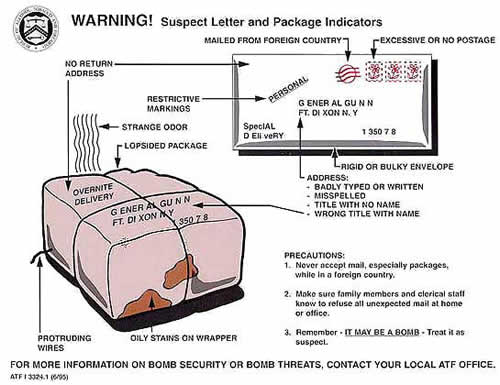
What constitutes a suspicious letter or parcel?
Some typical characteristics which ought to trigger suspicion include letters or parcels that:
- Have any powdery substance on the outside.
- Are unexpected or from someone unfamiliar to you.
- Have excessive postage, handwritten or poorly typed address, incorrect titles or titles with no name, or misspellings of common words.
- Are addressed to someone no longer with your organization or are otherwise outdated.
- Have no return address, or have one that can't be verified as legitimate.
- Are of unusual weight, given their size, or are lopsided or oddly shaped.
- Have an unusual amount of tape.
- Are marked with restrictive endorsements, such as "Personal" or "Confidential."
- Have strange odors or stains.
What Should I do if I Receive an Anthrax Threat by Mail?
- Do not handle the mail piece or package suspected of contamination.
- Make sure that damaged or suspicious packages are isolated and the immediate area cordoned off.
- Ensure that all persons who have touched the mail piece wash their hands with soap and water.
- Notify your local law enforcement authorities.
- List all persons who have touched the letter and/or envelope. Include contact information and have this information available for the authorities.
- Place all items worn when in contact with the suspected mail piece in plastic bags and have them available for law enforcement agents.
- As soon as practical, shower with soap and water.
- Immediately Report the incident to the Western Region Security Office on 206-526-6653, 206-526-6571, 206-526-4317 or 206-526-4100 (24hr emergency number).
The mail is safe! People shouldn't stop using the mail because of these isolated incidents. The simple act of paying attention to incoming mail will go a long way in keeping it safe and viable. Everyone, in the mailing community, as well as the American public, should exercise common sense.
Additional Information:
TRAINING - HOW TO RESPOND TO AN ANTHRAX THREAT
BASIC-LEVEL: (For people who sort, deliver, and open mail)
- Provides the facts about anthrax;
- Identifies what to look for in a suspicious letter or package;
- Outlines steps to take if anthrax is suspected; and
- Tells you who to call if you receive a threat.
BASIC FREE ON-LINE SLIDE PRESENTATION
ADVANCED-LEVEL: (For Managers and Trainers)
- Forms that anthrax may take;
- Symptoms and effects of an anthrax exposure;
- Treatment if exposed to anthrax;
- Steps to take immediately if anthrax is suspected;
- Resources available to help in the event of a threat.
ADVANCED FREE ON-LINE SLIDE PRESENTATION



 Current Threat level: Read the Department of Homeland Security web site for more information.